
Designing Electronics for Harsh Environments: What Actually Fails and Why
Cold is rarely the whole problem. Repeated change is often what does the damage.
Harsh environment electronics design is not entirely separate from ordinary product design. Extreme conditions accelerate many familiar failure mechanisms and can also introduce environment-specific ones. That one idea changes how you design, how you test, and what you ask before you start.
I spent last week at Lake Tekapo. Snow on everything, minus five most mornings, and I got sent out for coffee while my wife stayed by the fire. So I am walking back with two cups going cold in my hands, and instead of switching off like a normal person on holiday, I am thinking about why hardware dies in the cold.
The thought I came home with is simple. Harsh environments often bring forward failures that were already developing, while also enabling some failure mechanisms that would not occur under benign conditions.
It sounds obvious once you say it out loud. It changes how you design, though.
 Do harsh environments cause unique failures?
Sometimes. Harsh environments accelerate many ordinary faults, but they can also create conditions for specific failure mechanisms such as condensation, freezing, low-temperature lithium plating, or material embrittlement.
Run through what actually goes wrong when electronics hit the cold. None of it is new.
A marginal seal may leak sooner in a Tekapo winter because materials contract, stiffen, and move differently with temperature. Freeze-thaw cycles and condensation can also create failure conditions that may never appear in a stable indoor environment. A solder joint that cracks after one season of thermal cycling may have survived much longer in a stable environment. Repeated expansion and contraction accelerate fatigue, although there is no simple conversion between one harsh season and a fixed number of mild years. A plastic housing that splits in the snow may already have been poorly selected, aged, or stressed, but very low temperature can also push some plastics into a substantially more brittle state.
Many of these are familiar faults occurring on a shorter clock. Others only become possible when temperature, moisture, or materials cross a critical threshold.
That is the part worth holding onto. When we talk about ruggedised electronics or harsh environment design at Xentronics, we are not really describing a special category of product.
We are describing ordinary electronics product design under accelerated stress, with additional attention to environment-specific failure mechanisms.
Why harsh environment design is really longevity testing
Designing for a hard environment often resembles longevity design with the fast-forward button held down, provided the stresses reproduce the same failure mechanisms expected in service.
Most people file harsh environment design under niche. Something you only worry about for mining gear, alpine sensors, or defence.
I would push back on that.
A device that survives a Tekapo winter gives you useful evidence about how it handles thermal cycling, moisture, low-temperature operation, and material movement. It does not automatically prove a decade of life in a mild climate, but it can reveal weaknesses far earlier than ordinary use would.
This is the logic behind accelerated testing, and it helps to keep the methods separate, because they do different jobs. Highly Accelerated Life Testing, or HALT, pushes a design past its limits during development to find where the weak points are. Environmental Stress Screening, or ESS, runs on the production line to catch manufacturing defects in units before they ship. Accelerated Life Testing estimates how long a product will last by ageing it faster than real time. They share one idea: stress the product on purpose so its future shows up early.
So when a customer pays more for gear that copes with extremes, they are not only buying something that works in snow. They are buying evidence that known environmental stresses have been identified, tested, and designed around. Whether they like what they see is the real question.
What is one of the first questions to ask on a cold weather job?
Ask how often and how quickly the product changes temperature, as well as how cold it gets. The number and severity of transitions can expose failures that an absolute temperature rating alone will miss.
Here is the practical bit, and it is where a lot of environmental testing goes wrong before it even starts.
Datasheets, IP ratings, and battery specifications provide valuable limits and controlled test conditions, but they do not necessarily describe every combined stress a real product experiences. Field devices move between temperatures, humidity levels, vibration conditions, and operating states.
No real product stands still.
It may ride in a ute that swings from minus ten to plus twenty in a short period, several times a day. This avoids implying that the exact profile is typical without evidence.
It gets carried out of the snow into a warm cab, where water condenses on every cold surface inside the housing.
It gets put on charge while the cell is still below its permitted charging temperature, which can cause lithium plating, permanently reduce capacity, and increase safety risk.
The spec sheet says the device survives winter. It says nothing about surviving a Tuesday.
So one of the first questions we ask on a cold weather job is not only how cold it gets, but how often, how quickly, and across what range the temperature changes.
That question often surfaces risks that absolute maximum ratings alone do not reveal, because it forces you to consider thermal cycling, condensation, material movement, and changes in battery behaviour.
| The short version, if you want something to carry around
Cold does not kill hardware; change does. Almost everyone designs for the condition. Almost nobody designs for the crossing. |
The same rule applies to heat, dust, and vibration
The crossing matters as much in the Australian heat as it does in New Zealand snow. Different stressor, same design answer.
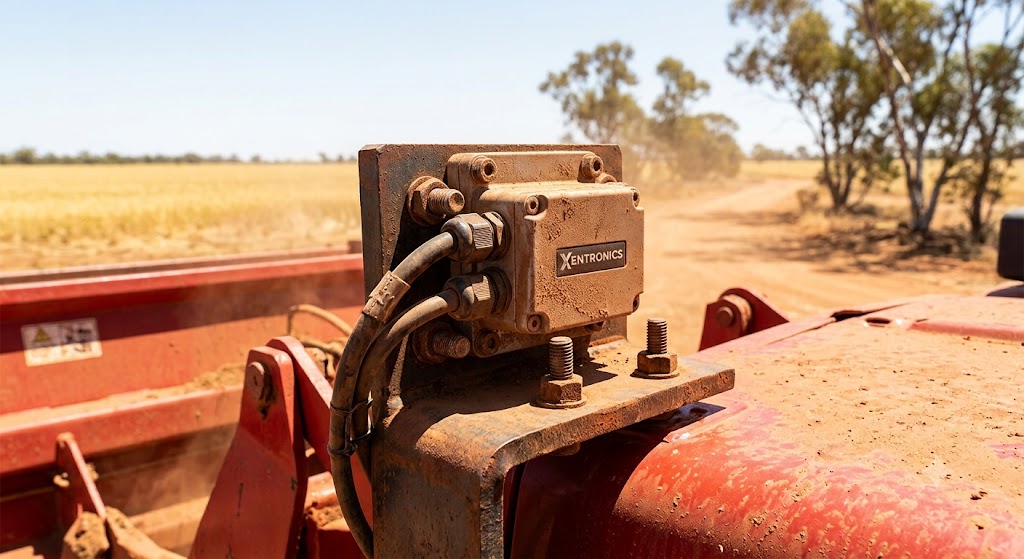
Snow is a clean way to tell the story, but most Australian hardware never sees it. The harsh environments here are heat, dust, salt, and vibration, and the logic does not change.
A sensor bolted to equipment in the Pilbara can experience very high daytime temperatures and a substantial overnight drop.
The original day-to-night claim is possible in some locations and seasons, but it reads as a general Pilbara condition and is unnecessarily vulnerable.
That daily swing is the same crossing problem the snow described, just running in the other direction. Agricultural gear across the outback eats dust and shock all day, so the failure that shows up is a connector working loose or a seal packing out, not a frozen battery. Anything near the coast fights salt corrosion, which finds every gap in a housing given time. On mine sites and in vehicles, constant vibration is the accelerant, loosening joints and fatiguing solder that would have sat quiet in a lab.
Find the worst repeated cycle the product will actually live through, and design for that cycle rather than a comfortable afternoon on the bench.
What to do with this on your own product
Be honest about your product’s worst repeated transition and design for that cycle instead of a steady condition.
You do not need to build for the Antarctic or the Pilbara to get the benefit. You need to be honest about your product’s worst repeated transition, whether that is temperature, humidity, power, dust, or vibration, and design for that cycle instead of a comfortable afternoon on the bench.
A few things earn their place once you start thinking in cycles instead of conditions:
- Rate components for both the full temperature range and the expected cycling, because extremes, thresholds, ramp rates, and repeated swings can each control different failure mechanisms.
- Deal with condensation deliberately, using measures such as enclosure design, controlled venting, drainage, suitable materials, or conformal coating where appropriate. Condensation commonly occurs when a cold product enters warmer, humid air.
- Treat the battery as its own problem, since charging behaviour below freezing can permanently cost you capacity.
- Remember that seals, cables, and plastics all change character with temperature, so a gasket that holds at twenty degrees may not hold at minus ten or at fifty.
None of that is exotic. It is the difference between designing for where a product sits and designing for what a product goes through. Whether you are building an embedded sensor node, a battery pack, or a full enclosure, the same logic holds.
Anyway, my coffee was stone cold by the time I got back to the room. A fair reminder that everything out here degrades faster than you would like.
Frequently asked questions
What is harsh environment electronics design?
Harsh environment electronics design is the practice of building electronic products to survive extreme conditions such as cold, heat, dust, moisture, salt, and vibration. It builds on ordinary electronics design but places greater emphasis on environmental stresses, material behaviour, protection methods, and accelerated testing. Many faults appear sooner under these conditions, while some failure mechanisms are specific to the environment.
Do cold conditions cause unique electronic failures?
Cold accelerates many ordinary failure mechanisms and can also enable specific ones, including condensation, freezing, material embrittlement, and lithium plating during low-temperature charging. A marginal solder joint, a weak seal, or an ageing plastic housing was always going to fail. Low temperature and repeated thermal cycling simply bring that failure forward.
What is the difference between HALT, ESS, and accelerated life testing?
Highly Accelerated Life Testing, or HALT, pushes a design past its limits during development to expose weak points. Environmental Stress Screening, or ESS, runs on the production line to catch manufacturing defects before units ship. Accelerated Life Testing estimates product lifespan by ageing it faster than real time. All three stress a product on purpose so its future shows up early.
Can you charge a lithium battery below freezing?
Charging a lithium battery below zero degrees can cause lithium plating, which permanently reduces capacity and can create a safety risk. A product used in the cold needs charging logic that checks cell temperature and blocks or limits charging until the battery is warm enough.
What matters most when designing for temperature extremes?
Both the extremes and the transitions matter. Important factors include minimum and maximum temperature, cycle range, ramp rate, dwell time, humidity, condensation, and the number of cycles. Design for the full operating profile, not only a single temperature rating.
Work with Xentronics
If you build hardware that has to hold up in the real world, cold, hot, wet, dusty, or shaken to bits, that is the kind of problem we like at Xentronics, an electronics product design consultancy working with clients across Australia and New Zealand.
We work across the whole path, from PCB design and assembly to the finished enclosure. Better collaboration delivers, and it delivers most when the environment is working against you.
| Ready to talk?
Tell us about the environment your product has to survive in. |